

I’ve been closely following the developments in Portugal’s tax incentives for foreign residents, and I have to say, the Non-Habitual Resident (NHR) program has been a game-changer for many of my clients looking to invest in the Algarve’s luxury property market.
Over the last 15 years, I’ve witnessed firsthand how these tax benefits have attracted high-net-worth individuals to our beautiful region, particularly to exclusive areas like Quinta do Lago and Vale do Lobo.
Sardo enjoys strategic relationships with local and national legal and accounting practices who are perfectly positioned and trusted to advise on all current tax structures available to investors who are looking to purchase property in the Algarve region. Please contact Sardo to discuss your requirements in the utmost confidence.
The Evolution of Portugal’s NHR Program
The Non-Habitual Resident program, introduced in 2009, has been a cornerstone of Portugal’s strategy to attract foreign investment and talent. It’s fascinating to see how this initiative has evolved, with the recent update in 2024 bringing significant changes to the landscape.
In my experience working with international clients, the NHR program has been a powerful draw, offering substantial tax benefits for a decade. The original scheme provided a flat 20% tax rate on certain Portuguese-source incomes and tax exemptions on almost all foreign-source income. This was particularly attractive for retirees and high-earning professionals looking to relocate to Portugal.
However, it’s crucial to note that as of January 1, 2024, the Portuguese government has introduced a new version of the NHR program, called the Fiscal Incentive for Scientific Research and Innovation (IFICI) Program. This update aims to focus more specifically on attracting highly qualified professionals to Portugal.
Key Features of the New NHR 2.0 (IFICI) Program
The new IFICI program maintains some similarities with the original NHR scheme but introduces several important changes:
- A special 20% Personal Income Tax rate on employment income for eligible professionals.
- A 10-year non-renewable period of benefits.
- Exemptions from income tax on various foreign income sources, except for those from blacklisted jurisdictions.
It’s worth noting that under the new scheme, foreign pensions are no longer exempt and will be subject to normal progressive tax rates in Portugal, ranging from 14.5% to 53%.
Comparing NHR 1.0 to NHR 2.0
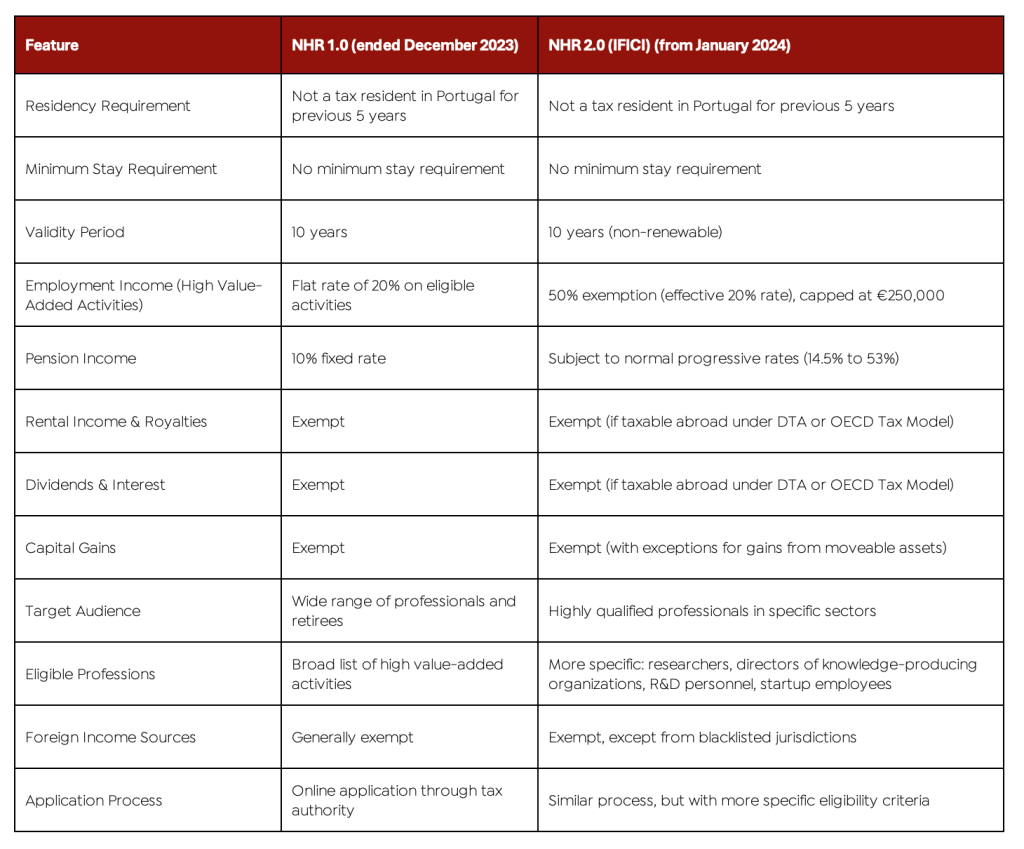
Eligibility Criteria for the New NHR Program
In my dealings with potential investors, I’ve found that understanding the eligibility criteria is crucial. The new program targets specific professional categories:
- Researchers with PhDs or those engaged in R&D projects.
- Directors or employees of Portuguese-based organisations producing knowledge.
- Highly qualified professionals in strategic sectors.
- R&D personnel eligible for Portugal’s R&D tax incentive program (SIFIDE).
- Directors or employees of accredited Portuguese startups.
It’s important to emphasise that applicants must not have been tax residents in Portugal for the previous five years and must not have participated in the previous NHR regime or other ex-resident programs.
Impact on Luxury Property Investment in the Algarve
From my perspective as a real estate professional in the Algarve, I’ve seen the NHR program significantly influence the luxury property market. The tax benefits have been a major factor for many international buyers considering high-end properties in areas like Quinta do Lago and Vale do Lobo.
While the new IFICI program may not be as broadly applicable as the original NHR scheme, I believe it will continue to attract a specific demographic of highly skilled professionals and entrepreneurs. This could lead to a shift in the type of luxury property investments we see in the Algarve, potentially favouring properties that cater to the needs of these professionals, such as those with home office spaces or proximity to innovation hubs.
Application Process for the New NHR Program
For those interested in applying for the new NHR program, the process remains similar to the previous scheme:
- Establish residency in Portugal.
- Obtain a Portuguese Tax Identity Number (NIF).
- Register as a tax resident in Portugal.
- Apply for the NHR status through the Portuguese Tax Authority’s website.
In my experience, while it’s possible to navigate this process independently, many of my clients find it beneficial to seek professional assistance to ensure a smooth application process.
In Summary
The evolution of Portugal’s NHR program reflects the country’s ongoing commitment to attracting foreign investment and talent. While the new IFICI program may be more targeted in its approach, I believe it will continue to play a significant role in shaping the luxury property market in the Algarve.
As always, I recommend that potential investors seek professional advice to fully understand how these changes might impact their specific situations. The Algarve remains an attractive destination for luxury property investment, and with the right guidance, the new NHR program can still offer substantial benefits to those looking to make Portugal their home.
Frequently asked questions
1. What is the Impact of Brexit on NHR?
The impact of Brexit on British citizens seeking Non-Habitual Residency (NHR) status in Portugal has been significant, especially as the NHR regime itself was officially discontinued at the end of 2023. For British citizens already holding NHR status, there is no immediate change; they can continue to benefit from the scheme for the remainder of their 10-year period.
However, Brexit has complicated residency requirements. UK nationals are now considered "third-country" nationals, meaning they must secure a valid residence visa to remain in Portugal beyond 90 days within a 180-day period. This adds an extra layer of bureaucracy for those wishing to maintain or apply for tax residency in Portugal.
For those hoping to apply for NHR post-Brexit, the situation is more challenging. The regime’s closure means new applications are no longer accepted unless specific transitional conditions were met by December 31, 2023. These include holding a valid residence visa or demonstrating pre-existing plans to relocate before the cut-off date.
Even with Brexit hurdles, British citizens who managed to meet these requirements can still apply during a transitional window ending December 31, 2024.
Looking ahead, the discontinuation of NHR and Brexit’s restrictions may reduce Portugal's appeal for UK nationals seeking tax advantages, though alternative programs like IFICI+ may emerge as replacements.
2. How does the NHR scheme affect digital nomads?
The Non-Habitual Residency (NHR) scheme in Portugal previously offered significant tax advantages for digital nomads earning income from foreign sources. Under the NHR, qualifying individuals could benefit from a 10-year exemption on foreign-sourced income, provided it was taxed in the country of origin or eligible under international agreements.
Additionally, Portuguese-sourced income from high-value professions was taxed at a flat 20% rate, making the scheme highly attractive for remote workers and freelancers. However, the NHR program ended for new applicants as of January 1, 2024, significantly altering the tax landscape for digital nomads in Portugal.
Without the NHR benefits, digital nomads residing in Portugal are now subject to standard progressive income tax rates ranging from 14.5% to 48%, depending on their earnings. They must also meet tax residency criteria, such as spending 183 days or more in Portugal annually or maintaining a habitual residence. For self-employed individuals, quarterly tax payments and social security contributions are additional obligations.
While the NHR’s closure limits tax incentives for new arrivals, those who applied before the deadline can still enjoy its benefits for up to 10 years. For others, Portugal remains appealing due to its quality of life and emerging alternative tax programs tailored to specific professions.